How this site was built
Claude Code wrote this site's code, tests and build logs, one session and one reviewed pull request at a time; Codex implemented one review follow-up. Paige made the decisions and merged every pull request. This page is the record: who did what, the plan, what went wrong and what caught it, and a log for every session.
Who did what
Generated by Claude Code
- The planning documents, drafted with Claude Code in a planning session on 2026-09-07, before any code; the design was approved that day, and later amendments are dated in place.
- The code, tests, CI workflow, build scripts and generators: one session and one pull request at a time, each session started from its prompt. The one exception is the September 13 review follow-up, which Codex implemented.
- The wording of the pages, drafted from Paige's resume and source materials, with every number held in content/ next to its source. The headline on Home is Paige's own wording.
- Every build log but that follow-up's, which Codex wrote, each with its record of what the AI got wrong; and this page, synthesis included.
Decided, reviewed or rejected by Paige
- The decisions: the sections, the stack, the visual direction, which projects get deep pages and in what order, the headline on Home, and the changes of plan. DESIGN.md and the plan record each one with its date.
- What may be published: she staged the source materials and decided what could appear on the site.
- Choices among the options a session put to her, which meant turning the others down: the JavaScript budget in Session 7 (three ranked options), the footer screenshots in S0-G (four), and GitHub Pro, declined on 2026-09-23 in favour of branch protection on a public repository.
- The review of every pull request, and every merge: no session merged its own work.
- The setup outside the code: deploying StimMap3D and making its repository public, and connecting Vercel.
Claude Code throughout, with the models each log records: Claude Fable 5.1, Claude Opus 5 and Claude Opus 5.5, and Claude Sonnet 5.5 for read-only screenshot checks in S0-G. Codex (GPT-6) wrote the September 13 review and its follow-up. The logs of Sessions 1 and 2 name the tool but not the model.
The plan
The planning documents set the work before any code was written, and every session amended them in place when a decision changed.
- DESIGN.md
- The decisions, site map, content model, visual direction, architecture and quality bar, with every amendment dated and credited.
- IMPLEMENTATION_PLAN.md
- The sessions in order, each with its tasks and acceptance list, and the launch steps.
- SESSION_PROMPTS.md
- The prompt pasted into the coding agent at the start of each session.
What went wrong, and what caught it
Every log has a section called "What the AI got wrong and how it was caught" ("What Claude got wrong" in the earliest ones). Read together (the logs written before this page) and grouped by what caught each item, they show which checks did the catching, and which checks exist because something got through.
This is an honest record of one site's build, written as the work happened. It is not research, a benchmark, an evaluation or a dataset. The counts are of items written in these logs, the grouping is one reading of them, and none of it says anything about coding agents in general. The gates were engineering, not an experiment.
A review pass115 items
A separate review of the branch or pull request before Paige's review: Claude Code's code review, a review agent, or a second Claude Code session, and once a Claude Code review of Codex's work. Automated review, not Paige's.
- The mobile contour was a crop of the desktop field again. Small review follow-up, 2026-09-13
- The Session 1 and 2 prompts and tasks were rewritten, altering the record. Small review follow-up, 2026-09-13
- Two build-log templates had diverged. Small review follow-up, 2026-09-13
- The Resume link was indented at 390 px. Small review follow-up, 2026-09-13
- A staged asset's digest was recorded but never checked. Small review follow-up, 2026-09-13
- The headshot loader's error did not say the asset must be an image. Small review follow-up, 2026-09-13
- Card copy dropped the capstone team size and the thesis method count. Small review follow-up, 2026-09-13
- StimMap3D's public commit count was recorded wrong. Session 0-D
- Checks stopped at the numbers: a block quote was attributed to a README section that does not exist. Session 0-D
- The first publication gate had gaps: a term wrapped across a line, staged names outside a folder, home-folder shapes, silent skips. Session S0-G
- The fixed gate still had gaps: long or bracketed old names, pattern terms across a line break, runs in a fork. Session S0-G
- The scrub went past removal in four places, dropping credits and decisions. Session S0-G
- Smaller scrub gaps: a dangling bullet, unmarked redactions, stale links. Session S0-G
- The link-accent utility emitted no CSS. Session 1
- The prose max-width token was never applied. Session 1
- The mobile menu's open state was keyed to the pathname. Session 1
- The contour's path data went over the wire twice. Session 1
- The end-to-end specs could run against a development server. Session 1
- outline-none removed the focus ring. Session 1
- git log ran once per route. Session 1
- Project names were typed into page copy. Session 1
- The third ink colour failed AA contrast in both themes, and axe never saw it. Session 1
- A fixed root font size overrode the reader's setting. Session 1
- Nothing enforced Prettier. Session 1
- A route count was off by one. Session 1
- The stock favicon shipped. Session 1
- A shell call through cmd.exe ate the git format string. Session 1
- The footer date was a day ahead. Session 1
- format:check would fail on a Windows clone with CRLF line endings. Session 1
- The accessibility gate skipped the 404 page and the open mobile menu. Session 1
- A stale production server could be reused by the specs. Session 1
- Home's "Download resume" button led to a placeholder page. Session 1
- The page scrolled sideways at phone width. Session 2
- A hidden tooltip widened the page. Session 2
- Bullets were not verbatim: dashes had changed. Session 2
- Metric matching had no token boundary. Session 2
- The GMLE certification printed twice. Session 2
- A deprecated image prop. Session 2
- A source label fell back to the raw source id. Session 2
- Pages imported raw content modules, skipping validation. Session 2
- StimMap3D appeared on About without its disclaimer. Session 2
- A figure caption overprinted at 768 px. Session 2
- A tooltip trigger was 11 px wide. Session 2
- The contour weighed more than its budget. Session 2
- Smaller cleanups from the review. Session 2
- Tooltips ran off phone screens. Session 2
- Tooltips failed WCAG 1.4.13 (dismissable, hoverable). Session 2
- Hero contour lines stopped short of the right edge. Session 2
- Splitting text by metrics could drop a metric. Session 2
- A private staging path was served in the /projects page. Session 3a
- Two metrics rendered without their source. Session 3a
- The case studies were reordered. Session 3a
- Three different definitions of a deep page. Session 3a
- Nested complementary landmarks. Session 3a
- A proof line carried numbers without metrics. Session 3a
- A fact typed as a page literal. Session 3a
- The EEG-TMS card named StimMap3D without its disclaimer. Session 3a
- loading="lazy" on a click-mounted iframe could outlast the load timeout. Session 3a
- Filter chips could be clicked before hydration. Session 3a
- A malformed MetricStat tag passed silently. Session 3a
- The claims gate over-counted a metric in a tagline. Session 3a
- The embed frame lost keyboard focus after loading. Session 3a
- The live region was inserted already filled. Session 3a
- A whole asset record, staging path included, was serialized into a client island's props. Session 3b
- The embed's two branches tested different conditions, so the disclaimer could fail open. Session 3b
- The aside's links bypassed both link gates. Session 3b
- A relaxed digest pattern turned a malformed revision into a skipped check. Session 3b
- A dead fallback in the capture script. Session 3b
- A cramped diagram at 390 px. Session 4
- A caption fact typed in a component. Session 4
- A figure could be numbered NaN or plot values out of scale. Session 4
- Two figures were numbered 1. Session 4
- Key collisions and long floats in the chart markup. Session 4
- A test that could never fail. Session 4
- A removed page was still inside the derived PDF. Session 4
- Page labels were off by one. Session 4
- A diagram note was not indented. Session 4
- The log named a commit that no longer existed. Session 4
- A margin utility did nothing. Session 4
- An h3 rendered larger than its h2. Session 4
- The StimMap3D timeline entry lacked its disclaimer. Session 5
- The dimming rule recoloured hover and the tooltip. Session 5
- The live region could announce a stale filter. Session 5
- The Home teaser had no size cap. Session 5
- CI never ran the explorer and projects specs. Session 5
- Teaser labels were sized wrong. Session 5
- prebuild rewrote the layout, so its guard could never fire. Session 5
- Transitions ran under reduced motion. Session 5
- Hovering under a filter dimmed the filter's own neighbourhood. Session 5
- Environment files loaded after the site URL was read. Session 6
- A stale overflow PDF survived a good build. Session 6
- No predev hook rendered the resume. Session 6
- Some strings bypassed the resume's font-run splitter. Session 6
- A document exception was itself phone-shaped. Session 6
- A NUL byte in the build log. Session 6
- The site URL was not validated. Session 6
- The resume's include flags were untested. Session 6
- Typos in regular expressions. Session 6
- Section headings were typed in the generator while AGENTS.md said no fact is typed. Session 6
- The JSON-LD escape did nothing. Session 6
- A trailing slash on the site URL failed the build. Session 6
- The resume generator ignored the production environment file. Session 6
- Definitions were attributed to the literature review's sources. Session 6b
- An entry count was wrong. Plan amendment, 2026-09-20
- A metric was sent to the wrong file. Plan amendment, 2026-09-20
- A label that fits was listed as one that does not. Plan amendment, 2026-09-20
- A change to Home's skills strip was called a reorder. Plan amendment, 2026-09-20
- An acceptance item was too broad. Plan amendment, 2026-09-20
- "Measured" covered one label, not two. Plan amendment, 2026-09-20
- The font spec skipped the 404 page. Session 7
- The local Lighthouse script could orphan its server. Session 7
- The served font family took the loader's const name, a reserved font name. Session 7
- The JS budget subtracted framework files the page did not load. Session 7
- A content-visibility rule contradicted what shipped. Session 7
- The plan called Session 7 shipped while it was in review. Session 7
The agent's own check68 items
Something the working agent did before committing: looked at a screenshot, measured, re-read a source or its own diff, or ran a scratch script.
- A find-and-replace swapped two headings and orphaned a prompt's body. Plan amendment, 2026-09-15
- Two cross-references said "above" for a note below. Plan amendment, 2026-09-15
- A draft run order dropped Sessions 6 and 7. Plan amendment, 2026-09-13
- A PowerShell pipe's encoding blocked Unicode replacements. Small review follow-up, 2026-09-13
- A spelled-out metric put its source button inside a hyphenated word. Small review follow-up, 2026-09-13
- A resume revision introduced claims the sources do not support. Session 0
- The same revision gave a leadership role the wrong start date. Session 0
- A resume draft ran to three pages. Session 0
- Two Session 4 tasks could not be done, and a third would have published an excluded page. Session 0
- The pull request's description was stale. Session 0
- The hero deep link pinned nothing: its preset was the default. Session 0-D
- Setup let an import create a production deployment that cannot be deleted. Session 0-E
- A smoke test pushed an already-deployed commit, and a stale status read as a pass. Session 0-E
- Changing the framework preset silently reset the Ignored Build Step. Session 0-E
- Backslashes broke two replacement scripts. Session S0-G
- A CI step lost its printf escape. Session S0-G
- Subagents dated their redaction notes with the session's start date. Session S0-G
- A rewritten log sentence read backwards. Session S0-G
- The commit-message check would have failed the first public commit. Session S0-G
- A directory change persisted across shell calls, and a write failed. Session 1
- Prettier rewrapped the planning documents. Session 1
- Prettier broke a block that had to stay verbatim. Session 1
- The Contact page showed list bullets. Session 1
- The contour ran behind the heading on mobile. Session 1
- A perl substitution mangled a test file. Session 2
- The hero failed the 30-second test. Session 2
- The small-screen field was a crop again. Session 2
- A tooltip used the wrong font. Session 2
- A certificate issuer had no source. Session 2
- "Independent project" headed the capstone page. Session 3a
- A spelled-out count sat in prose, outside the claims gate. Session 3a
- Two tests used a real repository's URL as their refusal case. Session 3b
- A 16:10 poster cropped the app's banner. Session 3b
- An element screenshot had the banner stitched in. Session 3b
- Lazy images were blank in screenshots. Session 3b
- PowerShell wrote a byte-order mark. Session 4
- Prose styles leaked into a diagram's list. Session 4
- A chart's peak label collided. Session 4
- Two thesis claims were drafted too strongly. Session 4
- Constellation labels piled up. Session 5
- A drafted amendment said there was no link field; there was. Session 5
- A literal NUL byte served as a key separator. Session 5
- The fix for it wrote the wrong text, twice. Session 5
- A header comment named the wrong path. Session 5
- The resume's page number never rendered. Session 6
- A tool decoded escapes into a NUL byte. Session 6
- The favicon came out black. Session 6
- Heredocs were rejected. Session 6
- The resume's provenance revision was stale. Session 6
- Two of three old label references were missed. Session 6b
- Three sentences the literature review does not support. Session 6b
- A module comment was false. Session 6b
- A phrase was looser than the resume's wording. Session 6b
- The review pass was narrower than asked. Session 6b
- A heredoc failed, and a script assumed Python. Session 6b
- A label change was said to need no layout regeneration. Plan amendment, 2026-09-20
- The headline was said to appear nowhere else. Plan amendment, 2026-09-20
- Grid classes that do not exist were named, and two tests missed. Plan amendment, 2026-09-20
- The new deep page was said to register nothing. Plan amendment, 2026-09-20
- A heredoc hit a file-name length limit. Plan amendment, 2026-09-20
- An inline script broke on an apostrophe. Plan amendment, 2026-09-20
- Thesis chart labels ran together at 360 px. Session 7
- A video's title ran under its button at 360 px. Session 7
- A Lighthouse aggregation called median-run was not the median. Session 7
- CI kept no Lighthouse reports. Session 7
- The extras fonts sat after Inter in the stack. Session 7
- content-visibility on the timeline nearly shipped, and broke anchor links. Session 7
- The plan still named the old font loader. Session 7
A unit or component test13 items
A Vitest test other than the claims and privacy gates.
- The contour grid overshot the view box. Session 1
- A fallback waited for an iframe error event that never fires. Session 3a
- A test fixture retyped research fields. Session 3a
- Grid cards rendered only the tagline, so a ranking went unrendered while the claims gate passed. Session 3a
- Heredocs halved the backslashes in a regular expression. Session 3b
- MDX expression attributes were silently dropped. Session 4
- A matcher was used where it cannot match. Session 4
- A slug equal to a research id broke a test. Session 5
- The literature review PDF had no title. Session 6
- The resume failed the orphan-object check, twice. Session 6
- A pairing was typed twice. Session 6b
- The plan's task list was incomplete in three places. Session 6b
- The font test expected a name record the subsetter drops. Session 7
An end-to-end test11 items
A Playwright test against the production build, other than axe.
- Two concurrent Playwright runs shared one results folder. Small review follow-up, 2026-09-13
- A test tried to focus a heading. Session 2
- A locator counted nested list items. Session 3a
- A live region sat in the server-rendered fallback. Session 5
- A pattern lost its backslash, and the screenshots timed out. Session 5
- A "flaky" tooltip test was smooth scrolling. Session 5
- A metadata test over every page timed out. Session 6
- A PDF check counted page objects in raw bytes. Session 6
- Pages below the root lost their Open Graph image. Session 6
- The tooltip test's wait raced smooth scrolling. Session 7
- A Lighthouse flakiness estimate was wrong within the hour. Session 7
The type checker or the build9 items
tsc, next build, the resume generator's page guard, or a failed deployment.
- The first Vercel build ran with no framework preset. Session 0-E
- Typecheck failed on a clean tree. Session 1
- Heredoc writes never landed. Session 2
- A Required<> type broke. Session 2
- __dirname pointed elsewhere under the bundler. Session 3a
- A click handler sat in a server-rendered fallback. Session 3a
- Git Bash's path rewriting broke the build. Session 5
- The resume overflowed to three pages, then four. Session 6
- The PDF renderer could not be required by the script runner. Session 6
The privacy or publication gate7 items
The phone pattern over every text file and shipped PDF, the staged-asset checks, and since S0-G the publication gate.
- Hex checksum digits matched the phone pattern. Small review follow-up, 2026-09-13
- Heredocs halved the backslashes in the new gate's own tests. Session S0-G
- A staged revision broke the digest check. Session 3b
- A random-number divisor matched the phone pattern. Session 5
- A document exception was too narrow. Session 6
- A log draft quoted a document identifier fragment. Session 6
- A log draft held a CI run id, which is phone-shaped. Session 7
The axe check1 items
Axe over every page in both themes.
- Dimming entries by opacity failed contrast. Session 5
Paige1 items
Something Paige asked or noticed. Her review at merge is not written into the logs: only Session 1's log records her verdicts, so this group counts what the logs say, not what she caught.
- The README's status had not changed since Session 2. Session 5
Gates added because of a failure
48 of the 229 items ended in a new test, check or rule, and 42 of those came out of a review pass: in each, the log says the gate was added because of that failure.
List them
- The privacy test recomputes every staged digest. After: A staged asset's digest was recorded but never checked. Small review follow-up, 2026-09-13
- Pattern, section and commit-message tests for the publication gate. After: The first publication gate had gaps: a term wrapped across a line, staged names outside a folder, home-folder shapes, silent skips. Session S0-G
- A test per gap, and the old names moved into the private term list. After: The fixed gate still had gaps: long or bracketed old names, pattern terms across a line break, runs in a fork. Session S0-G
- format:check as the first step of CI job 1. After: Nothing enforced Prettier. Session 1
- Axe scans the 404 and the open menu. After: The accessibility gate skipped the 404 page and the open mobile menu. Session 1
- An end-to-end overflow check at 360, 390 and 1280 px. After: The page scrolled sideways at phone width. Session 2
- The same overflow check. After: A hidden tooltip widened the page. Session 2
- The claims gate uses the renderer's matcher (in part). After: Metric matching had no token boundary. Session 2
- The ESLint rule that forbids importing content/ outside the loaders. After: Pages imported raw content modules, skipping validation. Session 2
- The path-data cap, lowered to 6.5 KB (in part). After: The contour weighed more than its budget. Session 2
- An end-to-end check that every tooltip stays on screen at 360 px. After: Tooltips ran off phone screens. Session 2
- A contour test that a line reaches the edge. After: Hero contour lines stopped short of the right edge. Session 2
- A unit test for the split. After: Splitting text by metrics could drop a metric. Session 2
- Unit and end-to-end checks that no staging path reaches served HTML. After: A private staging path was served in the /projects page. Session 3a
- The claims gate counts only rendered text; a test gives every metric its source button. After: Two metrics rendered without their source. Session 3a
- A test pins the featured order. After: The case studies were reordered. Session 3a
- A no-JavaScript test that the live region is absent (in part). After: Filter chips could be clicked before hydration. Session 3a
- A malformed tag fails the claims gate (in part). After: A malformed MetricStat tag passed silently. Session 3a
- A test that no deep-page tagline holds a metric. After: The claims gate over-counted a metric in a tagline. Session 3a
- A focus test. After: The embed frame lost keyboard focus after loading. Session 3a
- A status-region test. After: The live region was inserted already filled. Session 3a
- The privacy check runs on every HTML page. After: A whole asset record, staging path included, was serialized into a client island's props. Session 3b
- The aside's links go through the publishable-link checks. After: The aside's links bypassed both link gates. Session 3b
- A test that the digest was read. After: A relaxed digest pattern turned a malformed revision into a skipped check. Session 3b
- The figure components throw at build (in part). After: A figure could be numbered NaN or plot values out of scale. Session 4
- A content test on figure numbering. After: Two figures were numbered 1. Session 4
- Orphan-object and page-count checks on every shipped PDF. After: A removed page was still inside the derived PDF. Session 4
- A page-label assertion. After: Page labels were off by one. Session 4
- Unit, component and end-to-end disclaimer tests. After: The StimMap3D timeline entry lacked its disclaimer. Session 5
- An end-to-end test that hovers a dimmed link. After: The dimming rule recoloured hover and the tooltip. Session 5
- A 16 KB unit cap on the teaser. After: The Home teaser had no size cap. Session 5
- CI job 2 runs the feature specs. After: CI never ran the explorer and projects specs. Session 5
- A label-fit test. After: Teaser labels were sized wrong. Session 5
- prebuild only checks the committed layout. After: prebuild rewrote the layout, so its guard could never fire. Session 5
- A reduced-motion test over every button. After: Transitions ran under reduced motion. Session 5
- A unit test over every node and edge. After: Hovering under a filter dimmed the filter's own neighbourhood. Session 5
- Excepted pages still reject four phone shapes. After: A document exception was itself phone-shaped. Session 6
- Resume test assertions on them. After: The resume's include flags were untested. Session 6
- A unit test of the escape. After: The JSON-LD escape did nothing. Session 6
- Unit tests for the site URL. After: A trailing slash on the site URL failed the build. Session 6
- The font spec covers the 404. After: The font spec skipped the 404 page. Session 7
- A font test that fails on such a const. After: The served font family took the loader's const name, a reserved font name. Session 7
- Trailer addresses are blanked before the term check, with a test. After: The commit-message check would have failed the first public commit. Session S0-G
- A content test that every GitHub URL is exactly the cleared repository. After: Two tests used a real repository's URL as their refusal case. Session 3b
- An end-to-end check at 360 px. After: Thesis chart labels ran together at 360 px. Session 7
- An end-to-end check at 360 px. After: A video's title ran under its button at 360 px. Session 7
- An anchor test in the explorer spec. After: content-visibility on the timeline nearly shipped, and broke anchor links. Session 7
- A test pins the revision format. After: A staged revision broke the digest check. Session 3b
In the logs' words
Verifying the number in a claim is not the same as verifying the sentence around it.
The session's own aside link is a cleared-repository URL, so nothing shipped wrong; the gate was the defect.
Neither defect widened the page, so no existing check could see them; each has an e2e check that fails on the old markup.
What worked
- A review pass before most merges. It caught more than any other check, and most of the gates added because of a failure came out of one. Session 1, Session 2, Session 3a, Session 5
- Looking at screenshots in the session. Layout defects that no check could see were found in the captures, then pinned with a test. Session 1, Session 2, Session 7
- Generated files committed, with a --check in prebuild: a deploy runs no generator, and CI proves the bytes reproduce. Session 5, Session 7
- Open questions written as ranked options with the evidence, so Paige's answer is a choice, not a re-investigation. Session 1, Session 7
What did not
- Checks that read text rather than the rendered page: the claims gate passed while a ranking went unrendered. Session 2, Session 3a
- Shell heredocs and escapes on Windows: backslashes and bytes went missing in session after session. Session 2, Session 3b, Session 5, Session 6, Session S0-G
- Estimates from too little data: a number put on the Lighthouse gate's flakiness was wrong within the hour. Session 7
The build log
The public history begins at launch; the counts below are a snapshot of the pre-launch history, and the build logs are the record of the build.
19 pull requests merged between and , and 249 commits on the main branch, 19 of them merges. Snapshot of , taken by hand during Session 9, before its own pull request merged.
Every entry below links to its full log: goal, what shipped, decisions, tools, and what the AI got wrong; most also record how the work was verified. Pull request numbers refer to the private pre-launch repository.
2026-09-08
Session 1
PR #1
Scaffold, design system, shell
Stand up the repo so every later session only adds content: Next.js 16 scaffold at the repo root, the design tokens and typography from DESIGN §4, a shell (header, nav, theme toggle, footer) on every DESIGN §2 route, the contour hero motif, the test harness (Vitest, Playwright + axe, screenshots), CI jobs 1 and 2, and the project docs (README, LICENSE, CLAUDE.md, this log).
2026-09-09
Session 0-E
PR #2
Connect Vercel
Complete prerequisite S0-E (IMPLEMENTATION_PLAN §3): connect the private repo to Vercel so every later PR has a preview URL to review — while keeping the half-built site private and out of search results until launch.
2026-09-10
Session 0
PR #2
spec amendments
Correct the three planning documents before Session 2 builds
content/from them. Three rounds of amendments, all approved by Paige: the resume-PDF and Vercel facts (2026-09-10); the source review that checked every seed fact in DESIGN §3.2 against the staged sources and LinkedIn (2026-09-11); and a review of the specs’ own instructions, which found three Session 4 tasks that could not be carried out against the sources that actually exist (2026-09-12).2026-09-12
Session 2
PR #3
Content model, Home, About, Experience
Turn the Session 1 shell into a site that says something true: a typed
content/tree that every page renders from (DESIGN §3.1), the claims and privacy gates as tests, aMetricStatthat gives every number a source, and three pages — Home (passing the DESIGN §1 30-second test at 1280 px), About and Experience.Read the log: Session 2 — Content model, Home, About, Experience
2026-09-13
Small review follow-up
PR #4
Small review follow-up
Implement the requested small follow-up: tablet navigation, homepage hierarchy, a motion decision, shared agent instructions, accurate README/DESIGN status and the asset schema amendments.
2026-09-13
Plan amendment
PR #5
split Session 3 into 3a and 3b
Let work continue while StimMap3D's deployment (S0-D) is still in progress. Session 3 required S0-D before it could start, and Session 4 builds on Session 3's MDX pipeline, so both sessions were blocked on the deployment.
Read the log: Plan amendment — split Session 3 into 3a and 3b
2026-09-13
Session 3a
PR #6
Projects index, MDX pipeline, EmbedFrame, StimMap3D page body
Everything in the original Session 3 that does not need StimMap3D to be deployed or public (IMPLEMENTATION_PLAN split note, 2026-09-13): an MDX pipeline for project pages, Session 2's
content/projects.tsfolded into MDX frontmatter, a card for every DESIGN §3.2 project, the/projectsindex with a URL-synced skill filter, a reusable click-to-loadEmbedFrame, and the StimMap3D page body with its disclaimer. Session 4 builds on this; Session 3b adds the embed, the live and repository links, the screenshots and the cover once S0-D is done.Read the log: Session 3a — Projects index, MDX pipeline, EmbedFrame, StimMap3D page body
2026-09-13
Session 4
PR #7
Capstone and thesis deep pages, Research, Leadership
IMPLEMENTATION_PLAN §4 Session 4 and its 2026-09-13 amendment, on top of Session 3a: write the capstone and thesis case studies with recreated or original figures (nothing cropped from a source PDF), ship the thesis PDF with original page 2 removed, build /research and /leadership from content, and reuse Session 3a's
EmbedFramefor the valedictorian video. S0-D was not needed and the StimMap3D page was not touched.Read the log: Session 4 — Capstone and thesis deep pages, Research, Leadership
2026-09-15
Plan amendment
PR #8
defer Session 3b behind Sessions 5 and 6
Keep the build moving while StimMap3D's deployment (S0-D) is still in progress. The 2026-09-13 split put Session 3b immediately after Session 4, so the whole plan stalled on S0-D again once Session 4 merged. Paige asked which remaining sessions could run first.
Read the log: Plan amendment — defer Session 3b behind Sessions 5 and 6
2026-09-15
Session 5
PR #9
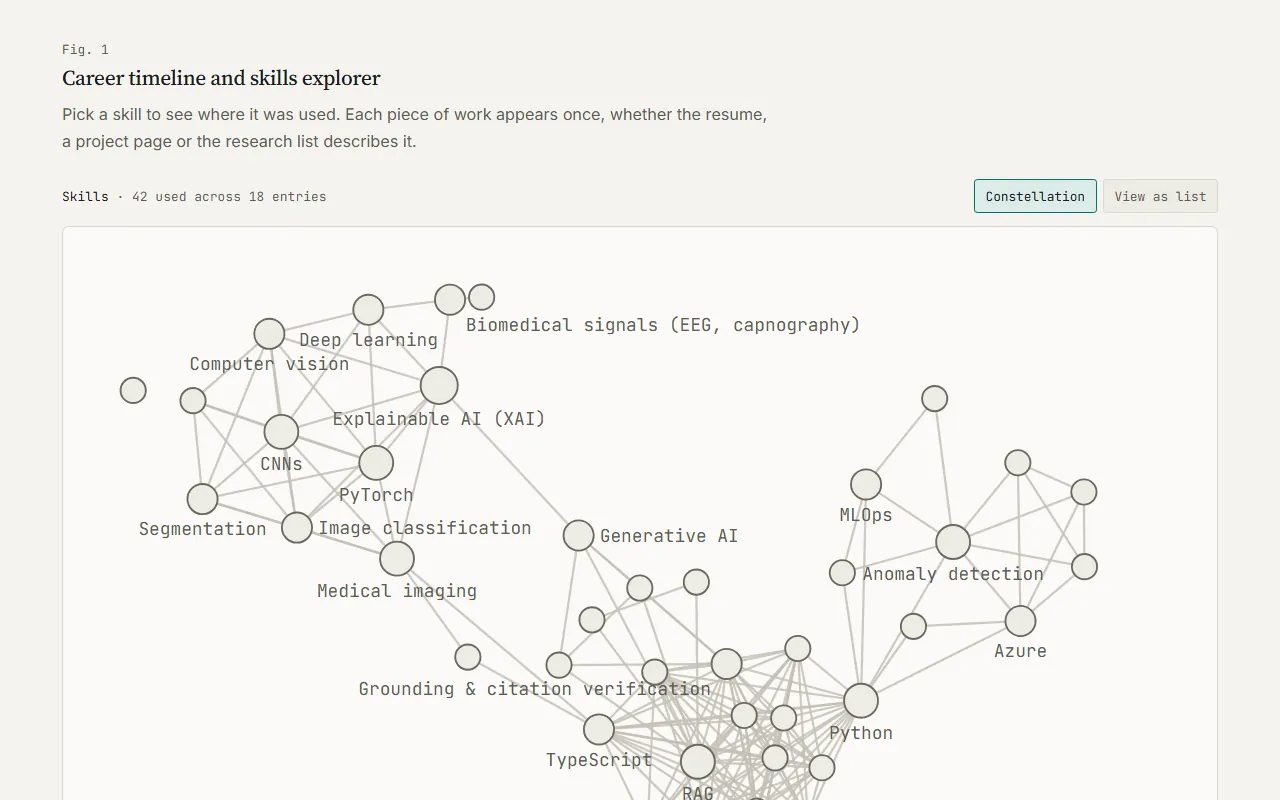
Career timeline + skills explorer
IMPLEMENTATION_PLAN §4 Session 5 with its 2026-09-15 amendment, run after Session 4 per the run-order change (S0-D and Session 3b not required): derive one explorer entry per piece of work from experience, projects and research, lay out the skills constellation deterministically at build, ship the timeline, filter chips and constellation as small client islands at the top of /experience with a static teaser on Home, and report the home page's JavaScript budget. The StimMap3D page was not touched; its missing links and cover are irrelevant to the explorer.
2026-09-16
Session 6
PR #10
Resume PDF from the single source of truth + SEO, Open Graph images, sitemap
IMPLEMENTATION_PLAN §4 Session 6 with its 2026-09-15 and 2026-09-16 amendments, run after Session 5 per the run-order change (S0-D and Session 3b not required): generate the resume PDF from
content/at build, gate it with tests, ship the GenAI literature review PDF, turn/resumeinto a redirect, and addmetadataBase, per-page metadata, the sitemap, robots.txt, Open Graph images, JSON-LD and a favicon. The StimMap3D page was not touched; its OG image renders from frontmatter and Session 3b re-checks it once thecoverexists.2026-09-20
Session 0-D
PR #11
Deploy StimMap3D and make it public
Close prerequisite S0-D (IMPLEMENTATION_PLAN §3), the last outstanding item before Session 3b: StimMap3D deployed, its repository public, and the live URL plus a DLPFC hero deep-link recorded where Session 3b reads them, plus the spec amendments that turn what S0-D found into decisions Session 3b can act on the moment this merges. Session 3b itself is explicitly not started here — no project content, component or asset was touched.
Read the log: Session 0-D — Deploy StimMap3D and make it public
2026-09-20
Session 3b
PR #12
StimMap3D live embed, public links and screenshots
Finish the StimMap3D page with the parts that needed the app deployed and public (S0-D, closed 2026-09-20): the click-to-load live embed, the live-app and repository links, four to six screenshots with provenance, and every quote and metric Session 3a placed re-checked against one pinned commit of the public repository. Nothing else: no other page, no change to the Open Graph card, no skills change.
Read the log: Session 3b — StimMap3D live embed, public links and screenshots
2026-09-20
Plan amendment
PR #13
add Session 6b, and open S0-F
Two things, both requested by Paige on 2026-09-20.
Read the log: Plan amendment — add Session 6b, and open S0-F
2026-09-20
Session 6b
PR #14
The headline and the interpretability thread
An editorial pass, not a feature: emphasis, ordering and vocabulary over facts already in
content/. One thread runs through the work — a system's output can be checked, the checker is itself tested, and the check runs automatically or it does not count. The session names that thread on Home, in About and on/research, gives the 2024 literature review on interpretability in generative AI a deep page in place of a one-line card, and moves the thesis to second of three case studies. It changes no fact and adds no claim.Read the log: Session 6b — The headline and the interpretability thread
2026-09-21
Session 7
PR #15
Accessibility + performance gates, cross-device polish
IMPLEMENTATION_PLAN §4 Session 7 with its 2026-09-15, -16, -17 and -20 amendments: confirm the axe sweep covers every route added since Session 1 (with the embed loaded and an explorer filter on), add Lighthouse as CI job 3 with DESIGN §5.7's assertions, fix what Lighthouse surfaces without relaxing a target, measure Home's JavaScript against 120 KB, sweep 360/768/1280/1920 px in both themes, and fix the 360 px tooltip test's wait. Nothing else: no content change, no new page.
Read the log: Session 7 — Accessibility + performance gates, cross-device polish
2026-10-01
Session S0-G
PR #17
Publication scrub
Prepare this repository's tree to become the first commit of the public repository (
PaigeRattenberry/paige-rattenberry-site, decision D3): add a publication gate that keeps local paths, staged file names and a private term list out of every tracked text file; bring the specs,AGENTS.md,README.mdand the build logs in line with the publication rules; and re-specify Session 8 and the launch for two repositories. No UI change.2026-10-01
Session 8
PR #18
How This Site Was Built, and launch preparation
IMPLEMENTATION_PLAN §4 Session 8 with its 2026-09-15, -16, -17, -21 and -30 amendments: a counts-and-dates snapshot of the pre-launch history (decision D6), the
/how-this-was-builtpage with every build log rendered as a timeline, the snapshot, a screenshot gallery, a draft synthesis of what the AI got wrong and what caught it, and StimMap3D as case study 1; then the launch checklist, executed and ticked in the PR, so the tree is ready to seed the public repository. No merge, and no change to any repository's visibility or settings.Read the log: Session 8 — How This Site Was Built, and launch preparation
2026-10-06
Session 9
PR #19
content update
A pre-launch content update: the Hammerspace pull-request count, a resume entry for this site, what the GMLE exam and SEC595 cover, Hammerspace, SHIELD and Stryker wording from the LinkedIn snapshot and Paige's dated entries in the inventory, credit for the thesis's evaluation design, a corrected incident passage on About, and a refreshed history snapshot, with the resume kept to two pages.
2026-10-07
Session 9b
PR #20
pre-seed fixes
Three small fixes before launch step L1, so the tree the public repository is seeded from does not carry them: build-log pages without an empty "Paige's review notes" heading, a README line for running the tests in a clone without the private term list, and "Built" in the thesis's first bullet.
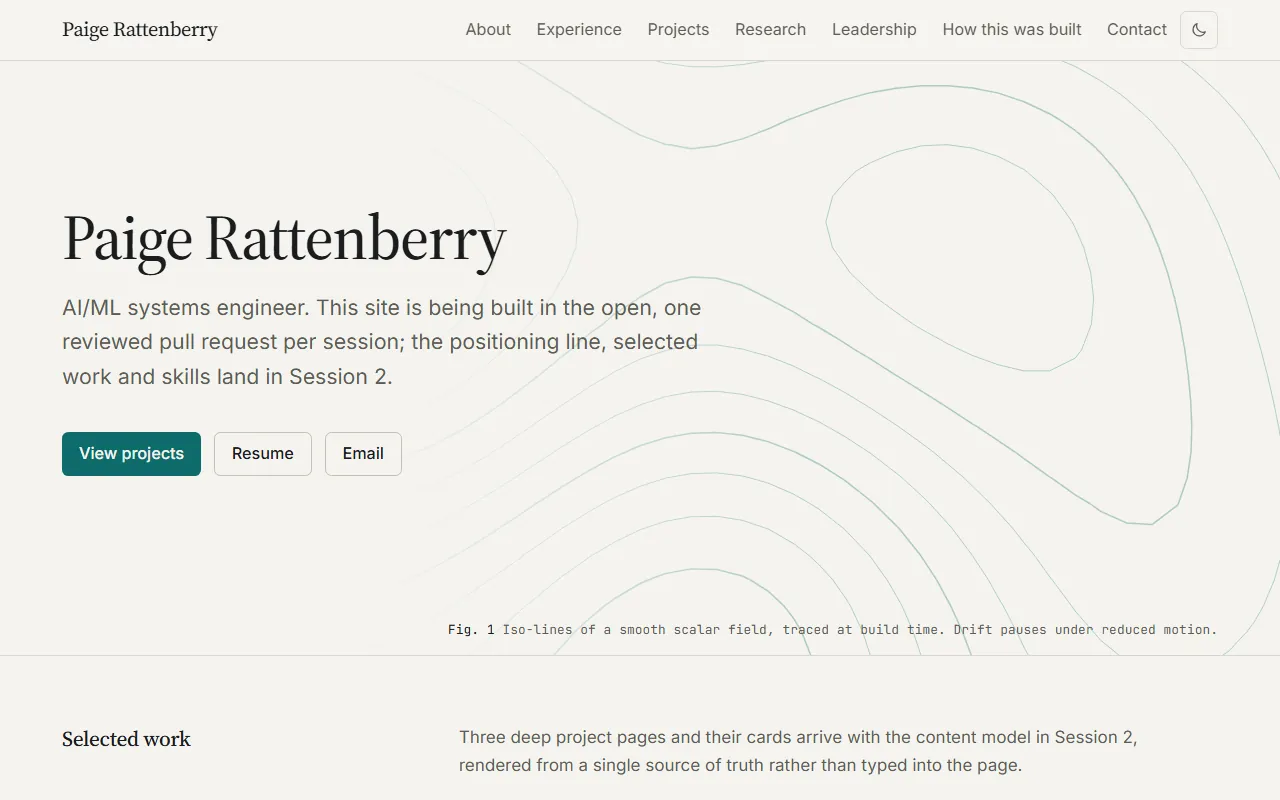
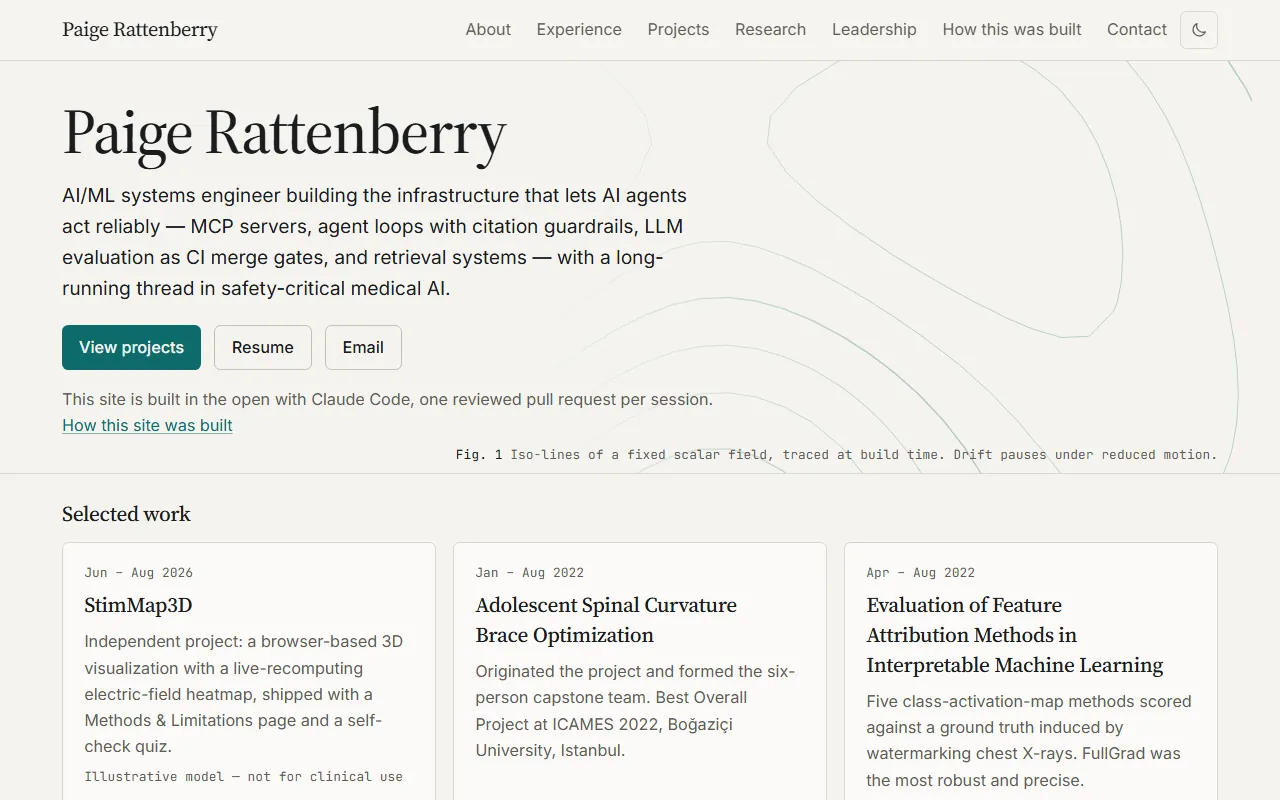
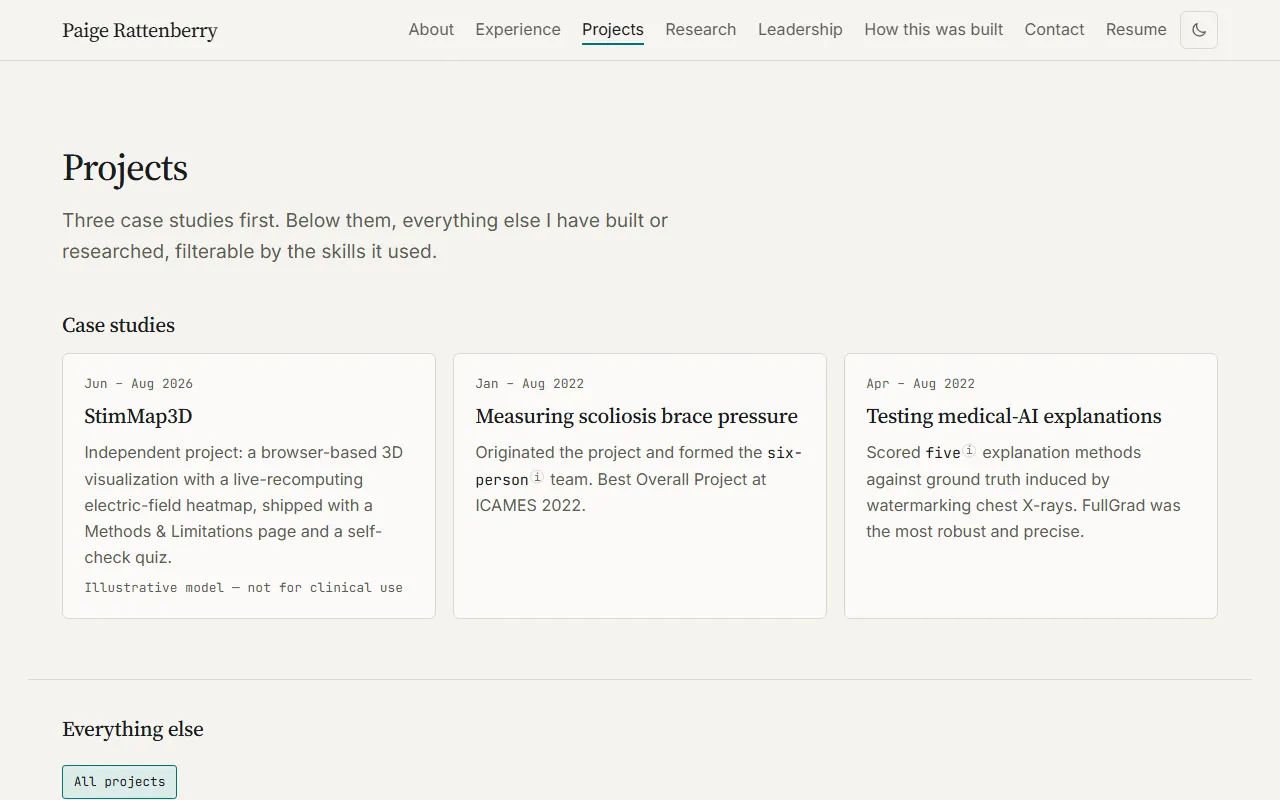
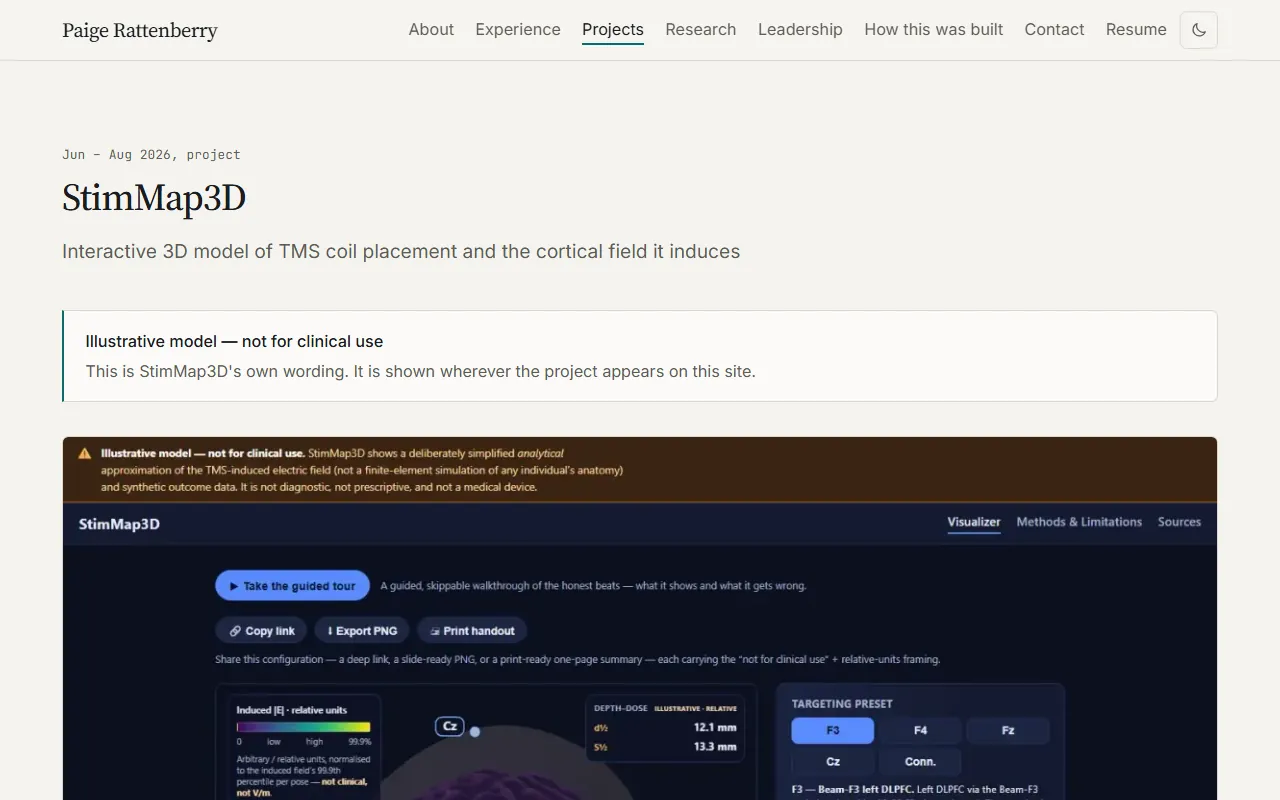
Screenshots
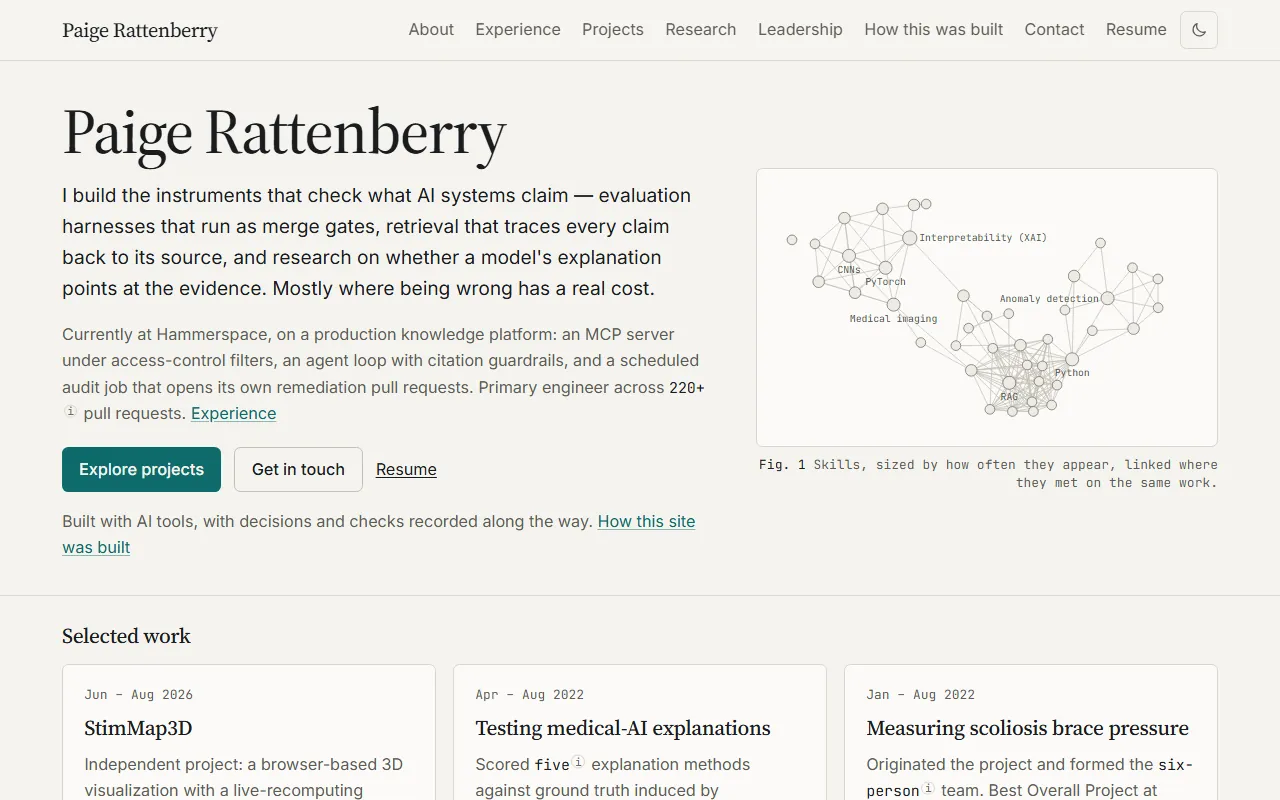
Each session that changed the interface saved screenshots of its pages to docs/screenshots/. A few, cropped to the first screen, show how the site changed.
Case study 1: StimMap3D
The first project built this way, and the pattern this site follows. It has no session pack of its own: its repository's notes on AI-assisted development are the record.
Interactive 3D model of TMS coil placement and the cortical field it induces.
StimMap3D was built with Claude Code between June and August 2026. Its repository describes the workflow: work is split around observable contracts, acceptance criteria name the failure cases before implementation, and the maintainer's decisions set the product scope and the scientific boundaries.
Its design document states the honesty gates its tests enforce, and its agent instructions repeat them for every session: the disclaimer on every route and exported figure, synthetic trajectories labelled, relative field units. It is explicit that automated review is not independent human review or clinical validation.
This site is built the same way, with a build log and screenshots recorded as each session lands.